
















Laptops

SAP S/4HANA Implementation at Rosenberger – Information for our Suppliers


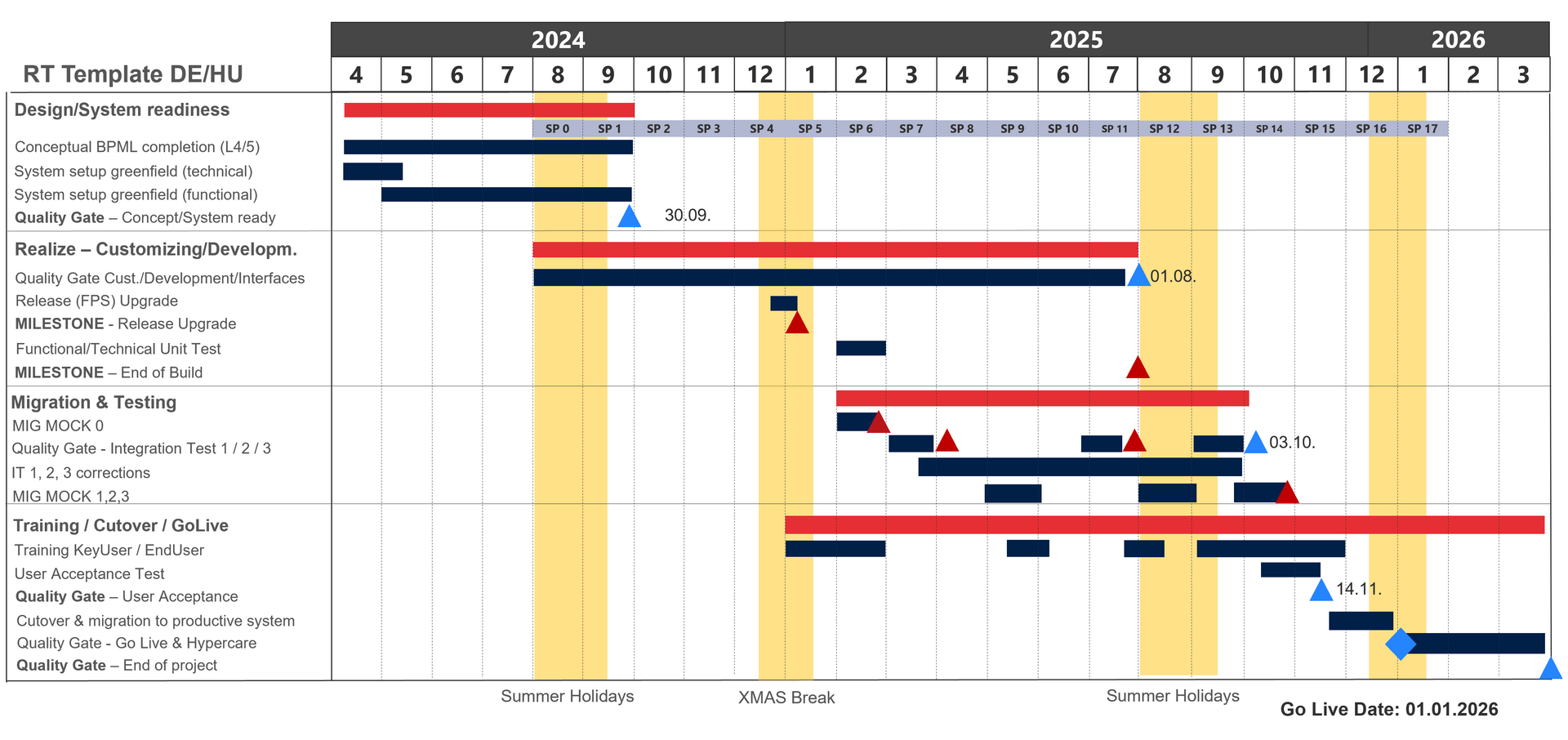
Rosenberger is modernizing its ERP (Enterprise Resource Planning) system and will switch to SAP S/4HANA on January 1, 2026. This affects the German locations in Fridolfing, Mühldorf, and Radeberg, as well as the plants in Nyírbátor and Jászárokszállás in Hungary.

With this strategic transformation, we are sustainably improving our internal processes – with the goal of making our collaboration with our customers and suppliers even more efficient, transparent, and future-proof.


SAP S/4HANA

SAP S/4HANA is SAP's latest ERP solution, based on the innovative in-memory database SAP HANA. It was developed to help companies manage their business processes in real time and meet the increasing demands of the digital world.


What does that mean for our suppliers?

Together with the introduction of the new system some organizational changes are coming along that will also impact our joint business processes – for example, in order processing, communication, or document exchange.

What is changing?

  • Plant separation of procurement entities
    As part of our organizational adjustments, we will implement a plant separation between Rosenberger Hochfrequenztechnik GmbH & Co. KG (hereinafter “RT”) and Rosenberger Magyarország Kft. (hereinafter “RoHu”). RoHu will no longer act as an “extended workbench”, but will operate as an independent purchasing organization in the future. Accordingly, all transactions – including orders, deliveries, and invoicing – will be handled separately on each site via the respective company code:

    • Each Rosenberger entity will plan and procure its requirements independently. As a result, invoicing will also take place directly between the ordering Rosenberger entity and the supplier.
    • In future, existing contractual agreements between RT and its suppliers (e.g., framework agreements, nomination agreements, scheduling agreements, NDAs) will also form the contractual basis for RoHu's cooperation with suppliers based on a separate agreement. 
       

    For you as a supplier, this means that existing agreements will be extended to include another Rosenberger entity. If you have any questions or concerns regarding the planned migration of your supplier master data to RoHu, please reach out to your existing contacts at Rosenberger at your earliest convenience.

  • Introduction of new supplier numbers
    As part of our transition to SAP S/4HANA, each supplier will be assigned a new supplier number based on a unique legal entity and managed as a unified business partner. If a business relationship exists both as a customer and as a supplier, it will henceforth be managed under a single BP number (Business Partner).
     
  • Extended use of scheduling agreements and EDI integration
    To increase process reliability and data quality, we will expand the use of scheduling agreements and EDI functionality. Our aim is to process all serial suppliers through scheduling agreements and EDI. 
     
  • Introduction of supplier batch numbers
    For improved traceability, the supplier batch number will be recorded in the goods receipt in SAP S/4HANA and will be requested from the supplier. A single-batch delivery is not required.
     
  • Structure of order confirmations and invoices
    Order confirmations and invoices must be sent exclusively to the predefined email addresses. All relevant information must be confirmed and match the purchase order in terms of content and structure.
     
  • Adjustment of recipient address for purchasing forms
    To simplify the dispatch of orders, contracts, and other purchasing documents, this will be sent exclusively to a central, predefined email address per supplier.
     
  • Transition to English as standard language for system-generated business documents
    Due to our international customer and supplier base and to simplify administrative processes, all business documents and labels will be issued in English only.
     
  • Standardization of delivery terms and payment conditions
    As part of the SAP S/4HANA-related adjustments to our delivery processes, and taking into account any existing agreements, we will preferably adopt Incoterm FCA as the delivery term and harmonize payment conditions.
     
  • Building safety stock prior to system go-live
    In order to ensure a smooth transition and continuous delivery capability during the go-live phase, we will initiate safety stocks in the preparatory phase following joint individual consultation.
     
  • Change of product groups
    As part of the revision of the product group structure, suppliers will be reassigned to the updated product groups. This will be implemented accordingly in the Jaggaer system.
     
  • Adjustment of the evaluation criteria for supplier evaluation
    Future supplier evaluation will include Rosenberger entities at the sites Jászárokszállás, Nyírbátor, Radeberg, and Fridolfing. Site-level evaluations will be possible. Quality KPIs are based on hard facts, while logistics KPIs are based on soft facts.
     
  • Harmonization and categorization of price conditions (surcharges and precious metal surcharges)
    The structure of price conditions for precious metal surcharges will be optimized to ensure that the respective metal categories and agreed prices are correctly displayed on purchasing documents. Other surcharges – such as transport or documentation – will in future be shown on the order documents via defined price conditions.
     
  • RFQs exclusively via Jaggaer
    Requests for direct purchasing will generally be handled via Jaggaer.
    Requests for indirect purchasing may be processed either via Jaggaer or Microsoft Office.
     
  • Tool management – tool tracking and reporting
    Tool information must be provided regularly. Depending on the tool, reporting on shot counts and tool conditions will be required monthly, quarterly, or annually. 
     
  • Metal chips – storage structure
    If metal chips are provided as part of the procurement process, a corresponding storage location must be created in SAP S/4HANA. Due to the separation of plants and the structure of the purchasing organizations, metal accounts on the supplier side must be managed separately by plant in future.
     
  • Required conditions for contracts
    As part of the SAP transition, it will be mandatory to maintain contract duration and related quantity information (e.g., in scheduling agreements). 
     
  • Logistics manual – standardization of packaging and labelling
    We are adapting our order and delivery processes to the requirements of SAP S/4HANA and the specified order structure. In the future, fixed packaging units and standardized labelling will apply in accordance with the logistics manual. This will improve warehouse efficiency and supply chain transparency. 
     
  • Harmonization of order units and order weight units
    To standardize and simplify processing, in future there will be only one defined order unit and order weight unit per product group.
     
  • Frozen zone – blocking period for transaction data during the system go-live
    During the frozen zone, transaction data such as orders, goods receipts, etc., will not be processed. This is intended to ensure a stable planning basis and avoid last-minute changes, to enable a smooth data migration to the new SAP S/4HANA system.
     
  • Scheduling agreements instead of quantity contracts
    In serial purchasing, all existing quantity contracts should be converted into scheduling agreements.


Frequently Asked Questions - General

Which Rosenberger locations are affected by the SAP implementation?

In this phase, the SAP implementation affects the Rosenberger Germany (Fridolfing, Radeberg) and Rosenberger Hungary (Jászárokszállás, Nyírbátor) sites. For all other sites, there will be no changes to the process until further notice.

Does your company already have experience with SAP implementation?

Rosenberger already has experience with SAP R/3, which is in use at our sites in Jászberény (Hungary) and Monterrey (Mexico). S/4HANA Public Cloud was successfully introduced at our plant in India at the beginning of 2025. The introduction of SAP S/4HANA represents a new step for our German locations in Fridolfing and Radeberg, as well as for the Hungarian plants in Jászarokszállás and Nyírbátor.

What kind of support does SAP provide?

MHP is acting as the implementation partner and is overseeing the entire rollout.  MHP is a system integrator that has already successfully implemented numerous projects in a wide range of industries, including the automotive sector. At the same time, an in-house consulting organization is being set up internally, which will take over operations after the go live.

How many key users are there?

Experience shows that one key user is needed for approximately 20 end users. Rosenberger has chosen a ratio of 1:8 for the introduction. These key users are distributed across all areas.

How is the staff trained?

The training is based on the ‘train-the-trainer’ principle and is conducted both in person and online. All training sessions are recorded and can be accessed at any time. Further information is available on a separate intranet page. The training program has already been launched and is being rolled out step by step.


Any Questions?

If you have any further questions about the implementation of SAP S/4HANA at Rosenberger and its potential impact on you, please do not hesitate to contact us. It's best to contact your usual contact person at Rosenberger directly. Alternatively, you can send an email to info@rosenberger.com.